Futu: You Are Not Alone
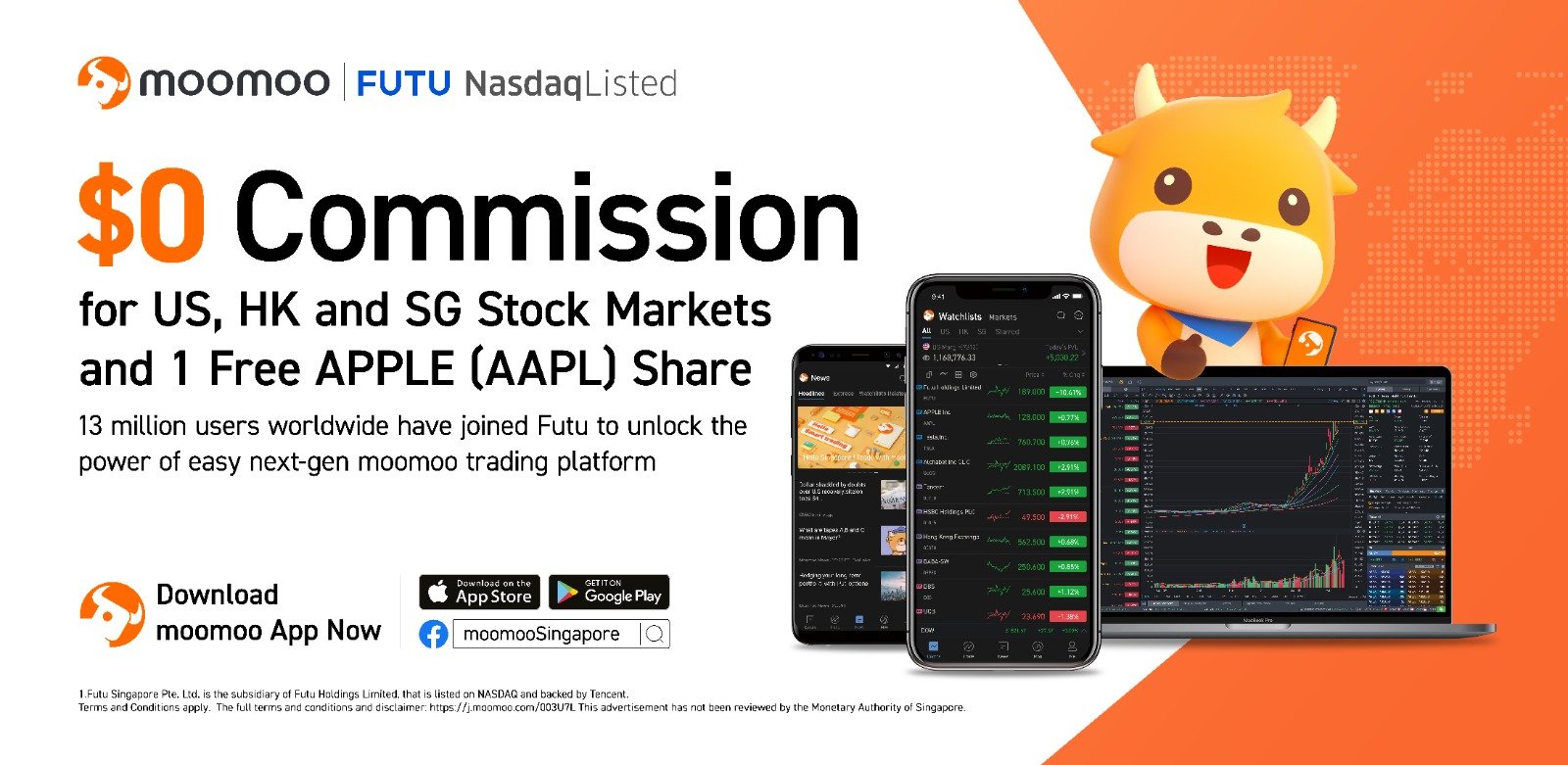
If you were in Hong Kong during The Great Bull Market of 2020-2021, you will surely remember the city plastered with ads from online stock brokerages exhorting commuters to sign up and begin trading. Moomoo, WeBull, Huatai, Huasheng, Tiger, Saxo, Interactive Brokers - they were all there!
Those go-go days are gone forever. But fortunately for Futu Holdings Limited (FUTU US) - developer of the Futubull and Moomoo brokerage apps - it made hay while the sun was shining, scaling its business at once-in-a-lifetime low costs and raising more than USD 1.2 billion equity from avaricious investors at the top of the market.
While Futu’s stock is still down more than two-thirds from its all-time high, it has transformed into something very profitable and quite sticky (with a 98 per cent retention rate among paid clients). From 1Q18 to 1Q23, Futu grew from 4.1 million to 20.0 million users; from 93 thousand to 1.5 million paying clients; from HKD 51 billion to HKD 453 billion daily average assets; and from 101 thousand to 514 thousand daily average revenue trades.
Along the way, it expanded its product portfolio to include currency trading, more derivatives and derivative strategies; brought its US clearing in-house to reduce costs; launched in the United States (2021), Singapore (March 2021), Australia (March 2022) and Malaysia (May 2023); syndicated 353 initial public offerings; signed up 662 companies to administer their employee stock option programmes; and built a wealth management business with assets under management of HKD 37 billion. It also received an order from the China Securities Regulation Commission clarifying a distracting regulatory uncertainty.
If Tencent Built a Broker:
What makes Futu distinct is its marriage of technology and social media.
Through its apps, Futu offers an ultra-low-latency, efficient and stable trading platform with access to equity and options markets in the United States, Hong Kong, mainland China, Singapore, Malaysia and Australia. The apps also have community message boards and newsfeeds where users can share their analyses and reactions. According to a 2022 article from Capital, users in Hong Kong, on average, generated more than 100,000 items of content every day.
It shouldn’t be a surprise that Futu is designed this way because its founder, “Leaf” Li Hua (李华), was Tencent’s eighteenth employee. As Leaf wrote to shareholders in Futu’s first annual report as a public company (reproduced in the Appendix below), he became interested in share trading after Tencent went public in 2004. Fascinated by markets, he became a self-described “heavy trader” but was shocked by how primitive and unreliable Hong Kong’s online trading systems were at the time.
Tencent’s success made Leaf financially independent before he turned thirty, and he left Tencent in 2008 to pursue a dream of building a better trading platform. Per Capital:
[Leaf was] determined to introduce the Internet thinking that puts user experience first into Hong Kong's financial service industry. Improve the user experience through independent research and development and product changes throughout the chain, so as to solve the problems of difficult account opening, slow transactions, and high commissions that investors in Hong Kong and US stocks often encounter.
At first, he learned from local brokerages by becoming a client. His trading volumes were staggering - with HKD 15 million capital in 2009, he reportedly made HKD 7 billion in transactions - and the brokers embraced him. When he offered to build trading software for them, they took him for a rube and happily gave him access to their back office staff. Leaf realised:
Simply put, it is to make the product well, to make the experience of the trading system smoother, and at the same time, the system must be stable and faster. This is actually a problem that can be solved through products and technology.
But when it came time to have his trading software certified by Hong Kong’s regulator, the Securities & Futures Commission, the brokers told Leaf he was on his own. So, he founded Futu in 2012, raised money from friends and family and was awarded a Type 1 Licence (Dealing in Securities) later that year.
As Leaf described in a 2016 interview, writing code was easy; the hard part was the challenge and expense of satisfying the securities regulators. Many of his ideas for a better user experience - such as video onboarding - ran contrary to the regulators’ principles for risk management. From Capital:
[Leaf] realized that the biggest difference between starting a business in this industry and the ordinary Internet field is that his "goodwill" did not count for anything with regulators. In the financial world, it is not enough to make a good product; feelings are feelings, and everyone must abide by the letter of the regulation.
To maintain sufficient liquid capital to satisfy his licence, and to pay for office space and staff, Futu raised money from Tencent, Matrix Partners and Sequoia in 2014, 2015 and again in 2017. Finally, Futu went public by listing on the NASDAQ in 2019. Leaf and Tencent are the company’s largest shareholders, respectively holding 36 per cent and 22 per cent of the total ordinary shares. Futu has a dual-class share structure, giving them 59 per cent and 35 per cent of votes.
THE FUTU APPS:
In case you’ve been wondering, “Niu” (牛) is slang for “awesome” in Mandarin, as well as evoking a bull market. Inspired by Tencent’s penguin, that’s why Futu chose an adorable little cow for its mascot.
Futu has three tiers of users. Anyone can download the app to check prices and read the news. You must register to leave comments. Finally, paying clients must fund their accounts with an initial deposit of at least HKD 10,000.
These tiers create a funnel for future customer acquisition. The ratio of registered users to total users has increased from 7.9 per cent in 1Q18 to 16.5 per cent in 1Q23, while the ratio of paying clients to total users has risen from 2.3 per cent to 7.6 per cent. The ‘drop through’ rate of paying clients to new users is even higher at 10.3 per cent.
Futu’s apps *look* and *feel* like they were designed by Tech people, not Finance people. They have a nice, clean design and a simple logic. And they are less clunky than professional brokerage apps. Here are some screenshots from Futubull of the Watchlist tab (left), the Markets tab (centre) and the Community tab (right, inside of the Discover tab), which surfaces user-generated content related to the stocks on my watchlist for me to read, comment on or share with friends.
Once you tap on a single security, you can access charts, tools for technical analysis tools and option chains. And, of course, trading is always just a button away.
It’s essential to see this in context: Futu primarily competes with banks, which leverage the inertia of their deposit relationships to cross-sell securities trading. Without meaning to pick on anyone in particular, here are some screenshots from The Bank of East Asia’s (“BEA”) dedicated stock trading app. Notice the difference? Futu also brings an internet company’s spirit of rapid product iteration. According to the Version History in the Apple App Store, the Futubull app was updated twenty times in the last three months, while BEA’s app was updated just twice.
How do users rate Futu’s apps in the Apple App Store?
In Hong Kong, Niuniu has a 4.7-star rating from 65 thousand reviewers versus 3.5 stars for AAStocks (2.3k reviewers), 4.7 for Tiger Trade (<1k reviewers) and 4.1 for Huasheng (<1k reviewers).
In Singapore, Moomoo has a 4.7-star rating on the Singapore Apple App Store from 12 thousand reviewers versus 4.4-stars for WeBull (<1k reviewers), 4.7-stars for Tiger Trade (13k reviewers), 4.5-stars for Citi (30k reviewers) and 4.7-stars for OCBC (90k reviewers).
In the United States, Moomoo has a 4.6-star rating from 17.5 thousand reviewers.
In contrast, BEA’s app received a 1.7-star rating from just 70 reviewers.
I thought these detailed reviews from the Singapore Apple App Store were interesting. (Note: they are not random, I just chose the first ones I saw under the app. And I chose Singapore because the reviews are in English).
A five-star rating for Moomoo from Russell C. on 31/7/23:
The Ultimate Investment Tool
I'm absolutely blown away by this investment app! As someone who's been looking to grow my wealth and secure a stable financial future, this app has been nothing short of a game-changer. First and foremost, the app's user experience is top-notch. Navigating through the various sections and tools is a breeze, even for someone like me who's not particularly tech-savvy. Another aspect that sets this app apart is the robust set of analytical tools it offers. I can keep track of my portfolio's performance in real-time, receive timely market insights, and even set up price alerts to stay on top of my investments. These features have given me the confidence to make informed decisions and adjust my investment strategy as needed. I can confidently give this app a well-deserved five-star rating. If you're serious about securing your financial future, look no further – this app is a must-have in your arsenal of wealth-building tools!
In contrast, here is a three-star rating for a competitor, the OCBC Digital Banking app, from cheeseburgerspy on 19/2/23:
Genuinely surprised to see this app having such a high rating. However upon looking through the reviews, I realised that there are many reviews voicing their frustrations only to have a 5 star rating pinned to it. Perhaps users aren’t familiar with the rating system. Anyway, this app is really unreliable. A common issue being…….app is not able to load at all, and if it did, another issue users might face would be the app being ‘temporarily unavailable’. In the event that users finally manage to enter the app, there will be times where users get logged out almost immediately due to ‘long periods of inactivity’. Truly dysfunctional. Whenever I intend to make a transaction via PayNow, I always check this app in advance as i truly have no idea when there would be errors in logging in (which then affects whether I am able to PayNow). This app has been problematic forever, so i’m not sure why it hasn’t significantly improved i mean isn’t the loading of the app and the log in something BASIC? I’m not even talking about how user friendly (or not) the app is, or about how the app could be potentially lacking in terms of features, or about the layout, etc. I just want the app to be FUNCTIONING in the first place
EXPANSION AND GROWTH:
Futu has room to grow:
In Hong Kong, by attracting new demographics like female customers and by taking more wallet share from incumbents;
In its new markets, Singapore, Australia and Malaysia
Into new services like Asset Management.
At the same time, by adding new features to its apps, it can steadily improve its value proposition and differentiation. As Leaf Li explained to Capital at the end of last year:
Futu is more like a typical technology company than a financial company. "The company has nearly 3,000 employees, and more than 65% of them are engaged in product research and development. This proportion will not change for a long time in the future, because there are still many things that need to be developed by ourselves."
Let’s start with Asset Management. This is a simple but powerful business: Futu distributes third-party funds through its platform in exchange for trailing commissions. There are virtually zero marginal costs, and yet it creates enormous inertia for customers to stay on Futu’s platform. Access to high-yielding money market funds has also been extremely popular with new clients this year as they look for better interest rates than their bank deposits. Since launching in 3Q19, Futu’s Wealth Management AUM has grown to approximately HKD 37 billion, with 15 per cent of paying clients using the service to manage an average balance of HKD 160,000 each.
Futu’s goal for Asset Management is quite straightforward, as management explained on the 1Q23 earnings call:
You can understand we're actually a very dedicated apprentice of Charles Schwab in the United States. So I think a lot of lessons we learned from Schwab is that eventually we want to be asset aggregators for our users and provide life -- provide lifetime service -- financial service down the road. So, so far, we do not set any specific targets in terms of portions between the wealth management AUM versus our clients' trading AUM. I think now the wealth management AUM roughly accounts to close to 10% of our total clients assets. Hopefully, I hope such proportion will continue to increase up to 20% to 30% in the next 3 to 5 years.
Regarding geographic expansion, Futu is somewhat limited because the power of its investment community will only be truly appreciated by Chinese speakers. Therefore, I expect it will meet greater success in Singapore, Malaysia and Australia (amongst the expat Chinese community) than in the United States.
Management did an excellent job articulating why they chose Malaysia, again from the 1Q23 call:
So the population of Malaysia is around 33 million with the Chinese population accounting for about 20%. And as of 2022, there were about 2.1 million active retail trading accounts for Malaysian stocks, while the number of trading accounts for U.S. stocks, Hong Kong and Singaporean stocks are in the hundreds of thousands and are constantly rising.
And we observed that the retail participants in Malaysia are gone and are highly accustomed to digitized products. And now the new personal accounts opened in 2022, 59% of them come from investors age 23 to 45.
Currently, in Malaysia, the traditional bank affiliated securities firms are dominant, while the online brokers started relatively late. However, due to the overall trend of younger retail investors and their high acceptance of Internet products, we think there is huge potential for online brokers to further penetrate. In Mainland -- sorry, mainstream Internet brokers such as Rakuten, iSPEED and MPlus are relatively small in scale and their product capabilities are pretty basic with almost no social community operations.
And on the other hand, our product capabilities have strong advantages, including a wider variety of products, advanced market data and order types and rich fundamental and technical analysis tools. And in addition, the trading fees for foreign stocks like U.S. stocks are pretty high in Malaysia, with each trade costing as much as USD 10 to USD 25 and Futu can greatly reduce the trading costs of these offshore stocks.
And finally, we have an active social community, which investor education materials and very strong Internet operational capabilities, all of which we think can provide Malaysian investors with a very differentiated experience.
I imagine there are any number of markets in Asia which fit the same description.
How profitable is Futu overseas, though? And how long does it take to break even? Management offered some hints on Singapore, with the implication that it is not yet in the black. Again from the 1Q23 call:
We entered into Singapore markets roughly 2 years ago. So the first batch of our core client cohort assets increased by 2 to 3x in the past 2 years. We're very encouraged to see the clients cohort and also the clients retention. So now for the first batch, 2 years -- the clients which we acquired 2 years ago, they have already surpassed our client acquisition costs, which means contribute to operating profit nowadays. I think we're extremely confident about our profitability and earning powers in the Singapore markets alone not only just because of the -- our cohort will continue to enhance our ARPU and the client assets, but more importantly there will be a lot of initiative efforts to cutting the costs down, not only the operating cost, but also the clearing costs such as our U.S. stock trading, which we still deal with our Singapore-based clients through our external partners. In the second half of this year, we do have a plan to gradually migrate our U.S. stock trading for Singapore clients from external partners to our internal U.S. clearinghouse. So this will also meaningfully decrease our costs relating to the U.S. stock trading which will further enhance our profitability in Singapore.
Reading A Broker’s Balance Sheet:
If you are reading this write-up, the chances are high that you invest and therefore have a brokerage account. Let me ask you then, when did you last read your broker’s financial statements? Do you even know what its balance sheet looks like?
In my humble opinion, America’s Interactive Brokers (IBKR US) sets the gold standard for a conservatively managed securities brokerage. It is well capitalised; holds client assets in only cash and short-duration government securities; is lightning-quick to liquidate margin accounts; and - since divesting its market-making business Timber Hill in 2017 - takes virtually zero inventory risk.
If you study Interactive Brokers, you will understand: it’s a cultural thing. Early in its history, it was almost destroyed in a single trading session. Founder Thomas Petterfy vowed never to let it happen again. Who else then would begin an investor presentation with such seemingly mundane details as those shown below?
I was extremely fortunate to be taught how to read a broker’s balance sheet by Ms Nancy Stuebe, Interactive Broker’s Senior Director of Investor Relations. Here are the main points relevant to this analysis:
A broker’s balance sheet looks inflated because it includes clients’ cash that has not yet been invested, reflecting the broker’s discretion over how that cash is invested. Once clients invest that cash into securities, the cash leaves the broker’s balance sheet. So, while a broker’s balance sheet may appear inflated at first glance, the cash held on clients’ behalf will match the payables owed to clients.
Brokers are typically restricted from investing client cash in anything but the shortest-duration securities. The problem which surfaced at Charles Schwab (SCHW US) this year occurred because it is actually regulated as a bank, not a broker, and is therefore allowed to invest in longer-duration securities. It did this and, unfortunately, called the interest rate cycle horribly wrong, leading to mark-to-market losses greater than its equity.
Brokers like FTX and MF Global got into trouble because they were desperate for cash and dipped into segregated client assets. This can happen when securities they own decline in value and they are obliged to post margin. Neither IBKR nor Futu engages in prop trading or market-making, so they are unlikely to put themselves in this position.
So how does Futu stack up against IBKR? The critical difference is that US regulations permit IBKR to lend client cash as margin loans. IBKR, therefore, does not require as much equity as Futu, nor does it need to rely on external funding from lenders and other brokers. On balance, I would argue this makes IBKR a more resilient business. But there are puts and takes: Futu has twice as much equity, and its funding is independent of the cyclical nature of clients’ cash balances.
HOW FUTU MAKES MONEY:
Futu has two primary sources of revenue: net broking commissions from trading and net interest income from margin loans. In 1Q23, these amounted to HKD 919 million and HKD 1,163 million, respectively. Broking is a cyclical business: people trade more and use more margin during bull markets. On a per-user basis, virtually all of Futu’s metrics are down from their peak in 1Q21. However, this has been more than made up for by the increase in paying clients from 790 thousand in 1Q21 to 1,528 thousand in 1Q23.
Digging deeper, net broking commissions have benefitted from a growing number of daily average revenue trades, higher commissions from derivatives (versus cash equities) and - since Futu took its US clearing operation in-house - a declining percentage of broking and processing fees paid to third parties. The latter has helped net commissions rise from 63 per cent of gross commissions in 1Q18 to 85 per cent in 1Q23. However, activity has slowed: paying clients were, on average, trading more than once per day in 1Q21 compared to once every three days in 1Q23. In aggregate, volumes in 1Q23 amounted to HKD 1.2 trillion, just 55 per cent of what they were at the peak of the bull market in 1Q21.
Net interest income has grown with the volume of margin loans and a wider spread. The outstanding balance has grown from HKD 4.1 billion in 1Q18 to HKD 34.5 billion in 1Q23, even as the average balance per paying client shrunk from HKD 42 thousand in 1Q21 to HKD 22 thousand in 1Q23. Yields have improved materially thanks to higher rates at the short end of the curve.
Futu has an enormous amount of operating leverage because most of the costs of its trading platform are fixed, and the marginal cost of adding new users is virtually zero. During the last few years, this was masked by heavy discretionary spending on customer acquisition as Futu prioritised user growth in Hong Kong, an intensely competitive market. When Futu pulled back from customer acquisition in 2022, it used the money for share buybacks instead, repurchasing 8 million shares at an average price of USD 31.25.
Futu has switched gears and is seeking growth again in blue oceans like Malaysia and Australia. Spending there is, to date, focused on localising the Moomoo trading platform, which is expensed as R&D. As management has pulled back on customer acquisition, operating margins have shot up again into the low 60s. Futu does not disclose its revenue by geography, so we do not know the extent of contribution from its new markets, nor how much they weigh on its profitability.
Futu earns a higher proportion of its revenue from broking than IBKR, which probably reflects the intensely competitive nature of the US market, where most firms now offer zero commissions in exchange for selling order flow or cross-selling other services and products. Futu also offers less interest to clients on their cash balances, which tells us that it is targeting a different customer group from IBKR (the average account at IBKR has approximately USD160k of equity, roughly four times more than the average account at Futu). Futu’s operating expenses are fifteen percentage points higher, which likely reflects its smaller scale and spending on growth.
Nonetheless, both firms were similarly profitable during the quarter, with Futu and IBKR respectively earning an annualised return on equity of 21 per cent and 23 per cent. Despite its lower margins, this was possible thanks to Futu’s materially higher asset turnover.
And how about against other competitors? This chart from IBKR’s June 2023 Investor Presentation compares its FY22 Net Profit Before Tax margin against the crowd. Futu’s FY22 NPBT margin was 51%, second only to IBKR. On the one hand, that’s not surprising: both are technology companies at heart. By emphasising in-house R&D, they create sizeable operating leverage. On the other hand, Futu’s scale is still much smaller than IBKR’s, and it is still investing heavily in growth.
THE REGULATORY BOMB:
Regulation has been the biggest uncertainty overhanging Futu since its listing.
While Futu is licenced and operates in Hong Kong, its headquarters and most of its personnel are in Shenzhen. Under whose jurisdiction does it fall, therefore? The Hong Kong or mainland securities regulator? Furthermore, Futu has advertised its overseas trading platform to mainland Chinese clients, seemingly contravening China’s closed capital account, which restricts the amount and purpose for which money can be remitted from the mainland to overseas accounts. Did its mainland Chinese clients fund their accounts legally? Finally, there were questions about whether Futu properly managed data collected from mainland account holders and transmitted abroad.
The uncertainty ended in December 2022 when the China Securities Regulation Commission (“CSRC”), the mainland Chinese securities regulator, announced that Futu and its peers would no longer be permitted to accept money from investors who did not already have an overseas broking account. Then in May 2023, the CSRC obliged Futu to remove its app from mainland Chinese app stores so that it could no longer be downloaded or updated, leaving existing customers stranded.
This is obviously not good for Futu’s business. Any future expansion into the mainland Chinese market will likely be met with resistance. And Futu had to cancel its Hong Kong listing days before it was set to proceed.
Management disclosed in the prospectus for its Hong Kong listing that at the end of 2021, 35 per cent of its paying clients were mainland Chinese (based on the identification they provided when opening their account). I suspect that number has declined since then as it has grown overseas.
One of Futu’s main draws has been access to hot initial public offerings (“IPOs”) of mainland Chinese companies, which it won in part by partnering with the companies listing to create employee stock ownership plans (“ESOPs”). Will mainland Chinese companies want an ESOP built on an app their employees can’t download? I assume not. So, unable to draw hot IPOs, Futu will surely lose some of its appeal.
On the other hand, the CSRC will permit Futu to serve its existing mainland Chinese clients and any new mainland Chinese clients who have existing overseas broking accounts elsewhere. The regulator is clearly not out to destroy Futu. And Futu reported on its 1Q23 call that it had made plans to assist those clients and said there was no abnormal churn or withdrawals following the CSRC’s instructions.
Most importantly, we have clarity now.
THE DARKER SIDE:
Fidelity, the US brokerage and asset manager, once concluded that the accounts of deceased investors performed better because they were less active. Someone should tell that to the clients of online brokers! By my calculations, Futu’s clients turn over their portfolios on average once a month (three times per quarter), down from a nosebleeding twice a month (six times per quarter) during COVID. These are not patient, long-term investors.
(Note: IBKR does not disclose its overall trading value, so I could not derive a similar figure.)
By pure coincidence, the mother of one of my son’s playmates is a sociologist who has studied brokerage apps in Hong Kong and her students’ relationships with them. One of her most striking observations is that the yawning wealth gap here has made many young people abandon their belief that hard work can earn them a respectable middle-class life. And who can blame them when Hong Kong is consistently ranked as the most unaffordable housing market in the world, for example? Why slave away just to buy a small apartment in the suburbs for more than USD 1 million?
Instead, they see risk-taking (expressed here as high-frequency trading) as their only chance to get ahead. And if it doesn’t work, they have nothing to lose anyway.
I write this not to exonerate Futu and certainly not to accuse or condemn it. I simply want to acknowledge the broader issue and Futu’s place within it.
Valuation:
Futu both enabled and embodied the stock market folly of 2020-2021. As the chart above shows, its valuation in the first quarter of 2021 reached the astronomical level of 113x forward PE. It is a vastly different business today and now trades at 15x forward PE.
Wrapping It Up:
My friend Brian Mushonga is extremely good at sleuthing out interesting companies from outside the mainstream. He presented Futu in September 2021 to an investment club of which I am a member. I asked him a question which he has given me permission to share here:
Q: What can we learn from the experience of eTrade and other new, online brokers during and after the dot.com bubble? Where are the parallels? Were investors making similar assumptions about their growth trajectories? And what happened instead over the decades which followed?
E*trade is an interesting case study. The company experienced rapid growth between 1997 and 2000 (revenue CAGR was 76% over this period), while normalised EPS went from $1.53 in 1997 to ($1.43) in 2000, as the company pursued an aggressive marketing strategy to gain new clients in the lead-up to the dot-com crash. As a result, in early 1999, analysts started valuing E*trade on revenues and not earnings, expecting that rapid client growth would lead to higher leverage in the future. However, expected future revenue sources seem to have been more blue-sky than grounded in the company’s actual operations and strategy (e.g. “We believe EPS upside is possible from many sources including international, licensing/joint ventures, advertising and fees from other services”).
Subsequent to the dot com crash, E*trade’s revenues flat-lined for the next four years ($1.43bn in FY2004 revenues vs. $1.41bn in FY2000). However, normalised earnings went from ($1.43) to $8.07 in FY2004, reflecting an aggressive approach to cost cutting by management.
In the run up to the dot-com crash, E*trade traded as high as $600/share (in April 1999), a level it never got back to until it was taken private by Morgan Stanley in 2020 for $58.74/share. Any investor who bought E*trade in the frenzied run up to the dot-com crash did not fully recover their investment.
Some of the lessons from the E*trade experience:
Elevated market conditions and trading activity may not give a sustainable and representative rate of average client revenues,
Particularly when combined with aggressive expansion that entails high client acquisition costs,
It is important to develop more sustainable revenue sources (e.g. asset/wealth management) in addition to volatile trading commission revenue,
Brokers need to be selective in client acquisition - it’s not the client numbers per se that matter but a broker’s ability to (sustainably) monetize its client base. All else being equal, higher average client balances are preferable to smaller ones.
Broking requires a truly scalable model to make it profitable on a sustainable basis.
In sum, E*trade used the internet to design a superior, low-cost web-based brokerage and hoovered up market share from the incumbents. Its profitability was masked by its frenzied customer acquisition. It was hit when the bubble burst but the underlying superiority of its product saw it through a mean bear market in the immediate years which followed.
Sound familiar? Futu is E*trade for a mobile-first generation of young investors in the Chinese-speaking worlds outside of mainland China (though it sounds like Futu’s financial model is far more profitable). Futu still carries the stigma of the COVID bull market but its transformation is evident to anyone who dares look.
Of course, it’s important to point out (again) that broking is a cyclical business. What if even this current subdued level of activity proves unsustainable? Then the “E” in the PE ratio above will prove illusory. The cycle is impossible to predict (at least, by me) but I do think Futu can offset cyclical headwinds with the tailwinds of its growth into new markets and new products.
I’ve tried to unpick the risks you can’t see in Futu’s balance sheet by comparing it with IBKR. At the end of the day, culture is paramount in financial organisations. Futu was built by a young technologist who wagered his fortune learning to build a trading platform which put the user first. IBKR was built by a young technologist who almost lost everything in a single morning in the pits of the Chicago Mercantile Exchange. I suspect the latter may have a more intuitive aversion to risk. That said, Futu has survived several episodes of extreme volatility in its ten-year history and came out with flying colours.
Futu is another situation where an innovative firm has the incumbents on the ropes, leaving them to face the ‘innovators dilemma’. I like the setup.
Disclosure: Longriver Investment Partners Limited manages the Longriver Partners Fund and separately managed accounts. These portfolios may hold or trade securities discussed in this article, and their holdings may change without notice.
Further Reading:
Futu - HKEX Prospectus (2022)
Futu - SEC Prospectus for Supplementary Listing (2022)
Capital - Li Hua, founder of Futu Securities. Ten years of innovation and change (2022)
Futu - Li Hua, founder of Futu Securities: How to "toss" from the IT industry to the CEO of a brokerage (2016)
CGTN - Interview with Li Hua (2021)
Ziet Invest - Moomoo Malaysia - What Can You Expect?
People’s Daily Online - The Personal Information Protection Law is about to come into effect, what should cross-border Internet brokerages do? (2021)
CSRC - Rectification of illegal cross-border business development of Futu Holdings and Tiger Securities (December 2022)
CSRC - Spokesperson of the China Securities Regulatory Commission answers questions from reporters about Futu and Tiger (February 2023)
People’s Daily Online - Futu and Tiger Securities will remove their apps from domestic app stores (May 2023)
The Guardian - I Put My Life Savings Into Crypto: How A Generation Of Amateurs Got Hooked On High Risk Trading
Rolien Hoyng - The price of speculation: fintech risk regimes in Hong Kong
Appendix: 2020 Letter To Shareholders
Dear Shareholders,
This is our first letter to you since Futu’s IPO and listing on Nasdaq in March 2019. I want to take this opportunity to share with you who we are and what we want to achieve.
In October 2012, Futu obtained a Type 1 License (Dealing in Securities) from the Securities & Futures Commission of Hong Kong. After over 8 years of business development, Futu now holds 35 licenses, memberships and registrations across Hong Kong, the United States, Singapore and Europe, and serves over 13 million users from over 200 countries and regions. As we execute towards our mission to “make investing easier and not alone,” we have transformed from a brokerage service provider to an all-rounded online financial services platform integrating trading, wealth management, market data and information, social collaboration and corporate services.
Our relentless focus on product and user experience
As the No. 18 employee of Tencent, I first experienced Hong Kong stock trading when Tencent went public in Hong Kong in 2004. The primitive user interface and cursory services of the Hong Kong brokers shocked me, who came from an internet company that attaches the most importance to cultivating the best user experience possible. I decided to leverage my product development experience to transform the trading experience of retail investors in Hong Kong by bringing interactive technology, digitization and social networking to financial services.
We have always been upgrading our products. In 2020, the eighth year after Futu’s inception, we still rolled out 86 iterations of our application and 3,900 new product features. Many product upgrade ideas originated from our users. Every day, product managers and I get tagged by many users in their NiuNiu Community posts on product suggestions. We treasure all user feedback and strive to respond to every single piece in a timely manner. We firmly believe that a good product must meet the evolving needs of its users, and we hope to continue improving our products and grow with our users.
In addition to our unwavering focus on user experience, we rapidly expanded our product portfolio. We started with Hong Kong cash equities trading services, and gradually expanded to cover the main products on major exchanges around the world, including US equities, China A-shares qualified under the Hong Kong, Shanghai and Shenzhen Stock Connect, options, futures, Hong Kong callable bull/bear contracts, and Hong Kong warrants. We also launched margin financing services for Hong Kong and US equities, IPO subscription services, and dark pool trading for Hong Kong IPOs. For many investors, trading and wealth management go hand-in-hand. Therefore, we launched Futu Money Plus in response to our clients’ increasingly diversified needs for wealth management. As of 2020 year-end, we established partnerships with 39 leading global asset managers, selectively offering approximately 100 top-notch fund products.
Going forward, we will continue to enrich product offerings, including global futures as well as tools and features to facilitate investing decision-making, thereby “making investing easier.”
Constructing an interactive financial ecosystem
The latter half of our mission is to “make investing not alone.”
The investing journey can be a turbulent one, with moments both high and low. For individual investors, investing can be a lonely process as they study business fundamentals, analyze macroeconomic trends, invest, anticipate market performances, review investing decisions, over and over again. It will be a much more enriching experience if investors can stay connected, share the moments of ups and downs with, and learn from, people who bear the same enthusiasm for investing. The NiuNiu Community enables this exact type of experience. This February, Futubull surpassed 1 million in daily active users for the first time and generated an average of approximately 310,000 user-generated content and over 3,000 posts of trading history on each trading day.
In the NiuNiu Community, users can post investment ideas and trading history as well as interact directly with over 700 companies, fund managers, media and key opinion leaders through posts and live-streaming. The NiuNiu Community helps investors enrich investing knowledge, identify fitting investment strategies, and establish rapport with other investors. This engaging social community contributes immensely to our competitive moat. Even the best investment tools may be replicated through time, but the content and culture of a community stand and persist. The many years of hard work we poured into cultivating the NiuNiu Community have translated into the unique community culture we have today. The caring and supportive atmosphere as well as the sense of inclusiveness and curiosity imbued in our NiuNiu Community promote user engagement and increase user stickiness.
2021 is the year of Futu’s internationalization
Following Futu’s growing market share among residents in mainland China and Hong Kong, we would like to expand our footprint into more countries with our moomoo app. Singapore and the United States come as strategic focuses of our international expansion in 2021. We believe our product that seeks for depth, perfection and connectivity can provide highly differentiated value propositions to retail investors in these markets.
Singapore’s financial industry is mature, with many established securities brokers. However, most brokers fail to meet investors’ needs in the mobile internet era, and charge exorbitant fees. We officially launched moomoo in Singapore on March 8, 2021, and have since then seen robust growth momentum and received encouraging user feedback. We are confident in our growth prospects in Singapore. Looking ahead, we will leverage Singapore as our entry point into the broader Southeast Asia market.
In the U.S., quite a few online brokers have developed trading platforms with easy-to-use interfaces and simple functions to cater to newbie investors. There are also well-established brokerage firms which provide advanced features but lack straightforward mobile experience. We believe that moomoo strikes a delicate balance between user-friendly mobile design and advanced product features, and can thus very well fill the market gap between incumbents and online brokers.
When I founded Futu nine years ago, I made the decision to develop a fully-proprietary closed-loop trading system in Hong Kong. This was not an easy nor fast path to embark on, but it allowed us to build a solid foundation to our business. Thanks to that decision, now we can quickly launch and upgrade products, expand our system, and replicate our business in new markets. Never has technology played a more transformational role in financial services, and we are committed to capturing the tremendous opportunities in this new era.
Leaf Hua Li
Founder, Chairman of the Board,
Chief Executive Officer and Chairman of the Technology Committee