Netease: The Right Stuff
Speaking at the a16z Summit in 2018, Bobby Kotick, CEO and the driving force behind Activision Blizzard, told the audience:
“I would say of the 28 years I’ve been doing Activision and the 30 something years I’ve been doing software, I’ve never seen more opportunities than exist today.
If you think just ten years ago, if you wanted to play video games, you either needed a USD1,000 PC or a USD300-400 video game console. And there really weren’t any other ways to play video games. But phones have ushered in this whole new opportunity.
For years – most of my tenure as CEO – we sold in developed countries to middle class consumers on expensive devices. Today, we sell in 196 countries around the world and anyone in any socio-economic strata can play games. That was the biggest shift that took place because now you have a truly global market.
The second thing that then happened is when you started to see the games become more social experiences. I can use a headset; I can talk with the person I’m playing with; I can play with anyone from around the world. The introduction of the social experience to me was the true transformation of the opportunity.
It certainly is an exciting time to be in gaming, both as a gamer and an investor. But Kotick’s epiphany is somewhat naive: making mobile games with social features which do well globally is very hard! Many have tried but few have succeeded. Fewer still have done so sustainably.
So when I heard Kotick’s pitch, I immediately thought of Netease, which has been making social games (massive multiplayer online role-playing games, or “MMORPGs”) since 2001, Mobile games since 2013 and expanding outside of its home market of China since 2017. Marry these thoughts together and you realise that Netease skated long ago to where Kotick says the puck is going. This makes me quite excited about Netease’s prospects for the future, particularly its international expansion.
BACKGROUND:
Netease was founded in Guangzhou in 1997 by William Ding (丁磊), a Zhejiang-native who had become immersed in the CFidoNet bulletin board craze of the early 1990s (see here and here). Inspired by Hotmail, Ding founded Netease to offer China’s first free email service. By licencing its email client to businesses and launching a popular news portal, Netease quickly became China’s first profitable internet company, inspiring a generation of entrepreneurs like Pony Ma (马化腾) (more here).
Coming out of the Dot.com bubble, Ding had a vision to make Netease into China’s best gaming company. A development team he acquired in 2000 went on to launch Westward Journey Online (大话西游 Online) in 2001; Westward Journey Online II (大话西游 Online II) (“WWJ II”) in 2002; and Fantasy Westward Journey (梦幻西游) (“FWJ”) in 2003, three self-developed PC MMORPGs which would go on to shape China’s game industry. And as Netease has grown these games; expanded from MMORPGs into new genres; licenced international IP; and begun its expansion overseas - its Online Game Services revenue has grown from RMB37m in 2002 to RMB53bn in the last four quarters, rising from 16% of revenue to 76%.
The Right Stuff:
How did Netease gain the relevant experience for today’s gaming market?
To some degree, it was an accident of history. Games in the West traditionally relied on a “pay-to-play” model where players would pay $60 for a disk or cartridge. But rampant piracy in China made this uncommercial, so MMORPG publishers pioneered a “free-to-play” model in which play was free but unique weapons and skins were for sale. This model is known as 道具收费 in Chinese and “micro-transactions” in English. The virtual goods sold could enhance players’ abilities - but more importantly, gave them social status within the game. This social status should not be underestimated; its allure is far more powerful than fancy graphics (as you can see below from this screenshot of FWJ Mobile) or complex storylines. It’s also key to understanding how this monetisation model has succeeded across so many different game genres.
Free-to-play requires designing games from the start to match the business model. While many traditional games follow a finite, linear story from A to Z, free-to-play games are typically open-ended and/or non-linear. To drive their narrative, free-to-play games feature regular updates, including new quests, maps and characters. The key to their financial success is longevity, which in turn requires balancing monetisation with the need to keep players engaged, excited and tantalised. Without this balance, special items lose their scarcity; some players become too strong; others lose social status; the game becomes less fun to play; and players leave. Netease’s FWJ was the first Chinese MMORPG to successfully strike this balance and it’s a testament to Netease’s skill at “Live Ops” (i.e. managing a game post-launch) that almost twenty years later, WWJ II, FWJ and their descendants had their best ever financial results this year.
I can’t stress enough the importance (and difficulty) of Live Ops to managing a game’s natural decay curve. They are what keep virtual worlds vibrant and players coming back, as you can see in the chart below which shows the monthly active users for WWJ II and FWJ. Netease’s two decades’ of experience with Live Ops is an asset, as are its teams of young developers who patch through updates, new quests and new in-game items on an almost weekly basis. Contrast this with traditional Western titles which may be updated annually (e.g. FIFA ‘19 to FIFA ‘20), or Nintedo games which may be updated just once or twice in a console cycle (if that).
Because only a small portion of players actually pay for free-to-play games, the model necessitates targeting the largest possible audience from day one. This in turn requires developing both software and hardware infrastructure which can scale quickly and cost effectively. With social games, there is also a coordination problem: how do you populate a virtual world? The catalysts for this are a large marketing budget and techniques to retain players for the critical first few days and weeks. Again, it’s complex and risky work.
Mobile games require another transformation in game design. Whereas players ‘dedicate’ time to PC and Console games, Mobile games fill ‘fragmented’ time like waiting in line, riding the bus and - yes - sitting on the toilet. Without wanting to be crude, can you imagine playing a AAA-title like “The Last of Us 2” while sitting on the can? Neither can I. In addition, Mobile games need to be engineered to run and play well on the constraints of a small screen with (until recently) limited computing power. If you look again at the screenshot of FWJ Mobile above, you can see that it has a straightforward UI (user interface) designed for thumbs, and its graphics don’t require heavy computing or lots of bandwidth.
When it came to the Mobile era, Netease pulled away from its peers a second time. Ding realised early on that Mobile gaming would be big and so established a dedicated Mobile Games R&D Centre in Hangzhou, far from the company’s home base in southern China. I think he wanted a skunkworks free from old assumptions, as well as to access the abundant (and cheap) talent from Hangzhou’s universities. They then threw spaghetti against the wall until they found what would stick: Netease had 3 mobile games in 2013; 20 by mid-2015; more than 50 by the end of 2015; and more than 100 by the end of 2017. Fast-forward to today and Netease earns 73% of its Online Game Service revenue from Mobile. It is without a doubt a mobile-first games company.
The Opportunity Overseas:
To summarise: successfully making social Mobile games requires a different philosophy for game design, gameplay and monetisation; a different technology stack; and the experience and resources to manage games over many years post-launch. The divide is as much a cultural one as it is one of experience or money; firms have to be designed and built around this specific purpose. So while more powerful smartphones and cheaper data are belatedly allowing many traditional game publishers to port their IP to Mobile, I think it will take far more for them to succeed. In contrast, Netease - and a few of its Chinese peers - already has the exact culture and experience needed for this new era. I expect therefore that we will see its international revenue grow meaningfully over the next few years as it capitalises on this opportunity.
Netease has a two-pronged strategy for international expansion. The first is self-led and includes entering new markets, opening new studios and making investments in existing ones.
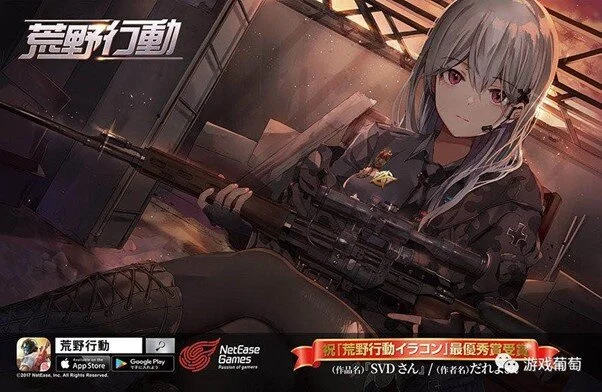
The company has been most successful to date in Japan, which was a smart place to begin given the size of the market and the disdain local developers have shown to mobile. Netease’s battle royale game ‘Knives Out’ has been a top-grossing game in Japan for most of the three years since its launch in 2017 (handily beating Fortnite and PUBG) thanks to Netease’s deep understanding of and appreciation for local anime culture, as well as some creative marketing techniques using streamers, social media and eSports. As a friend explained to me, the graphic at the top of this post shows precisely how Netease tailored the advertising for ‘Knives Out’ to appeal to Japan’s ACG culture: the character is female, she has a manga appearance, and she is armed with a sniper rifle (as Japanese players apparently prefer combat from a distance).
Netease’s ‘Identity V’ game recently joined ‘Knives Out’ as a best-seller on the Apple App store and Netease has also followed up by launching in Japan its first ever studio dedicated to consoles, which will hopefully promote more cross-platform functionality. The graphic below is from this studio’s launch and was simply too cool not to include in this post!
The second prong in Netease’s strategy for international expansion is to partner with foreign firms to take existing, universally recognised IP to Mobile for global markets - which is kind of the polar opposite to the hyper-localised approach it is taking in Japan.
Netease has long been a trusted partner to bring foreign IP to China, and has longstanding relationships with Activision Blizzard (Warcraft, DOTA2, Hearthstone) and Microsoft’s Mojang (Minecraft). Now Netease is leveraging its skills to take foreign IP to Mobile for global markets. Its pipeline includes CPC’s EVE Echoes; Warner’s Harry Potter and Lord of The Rings; and a multiplayer online battle arena (“MOBA”) game based on Marvel’s universe of superheroes (see below). Activision Blizzard has also partnered with Netease to take its blockbuster game Diablo to mobile. While in some ways Diablo Immortal is proving why it’s hard to make a game with universal appeal (the first demo’s graphics were perhaps drawn too much for Chinese tastes), I’m confident the outcome will be successful (see here, here and here for recent updates).
After all, it’s a strong endorsement of my thesis when none other than Bobby Kotick puts his money where his mouth is.
Disclosure: Longriver Investment Partners Limited manages the Longriver Partners Fund and separately managed accounts. These portfolios may hold or trade securities discussed in this article, and their holdings may change without notice.
Further Reading:
The Wikipedia entry on Video Game monetisation
An excellent overview of Netease’s history from Techbuzz China
An interview with legendary Chinese VC Kathy Xu, including her recollections on Netease’s trial by fire after its IPO
Xu Yiran (许怡然) on how FWJ managed its virtual economy
Why “pay-to-play” is really about social status
Niko on Netease’s 2020 Games Strategy
Niko on Asian Gamers’ preferences
Niko’s Daniel Ahmad on ‘Knives Out’ hitting #1 in Japan’s Apple App Store
KrAsia on Netease’s international expansion
Nikkei Asia on Netease’s entry into Japan
Netease opens its first console-focused studio
EEDAR’s comparison of Netease’s ‘Knive’s Out’ and Epic’s ‘Fortnite’
Why Nintendo struggled with and gave up on Mobile
Matthew Ball’s epic essay on Nintendo
Excellent charts on 2020 Mobile game data, highlighting RPGs high retention
Deconstructor of Fun on Genshin Impact
Deconstructor of Fun on Genshin Impact reaching USD400m sales