Podcast: Pandawatch88
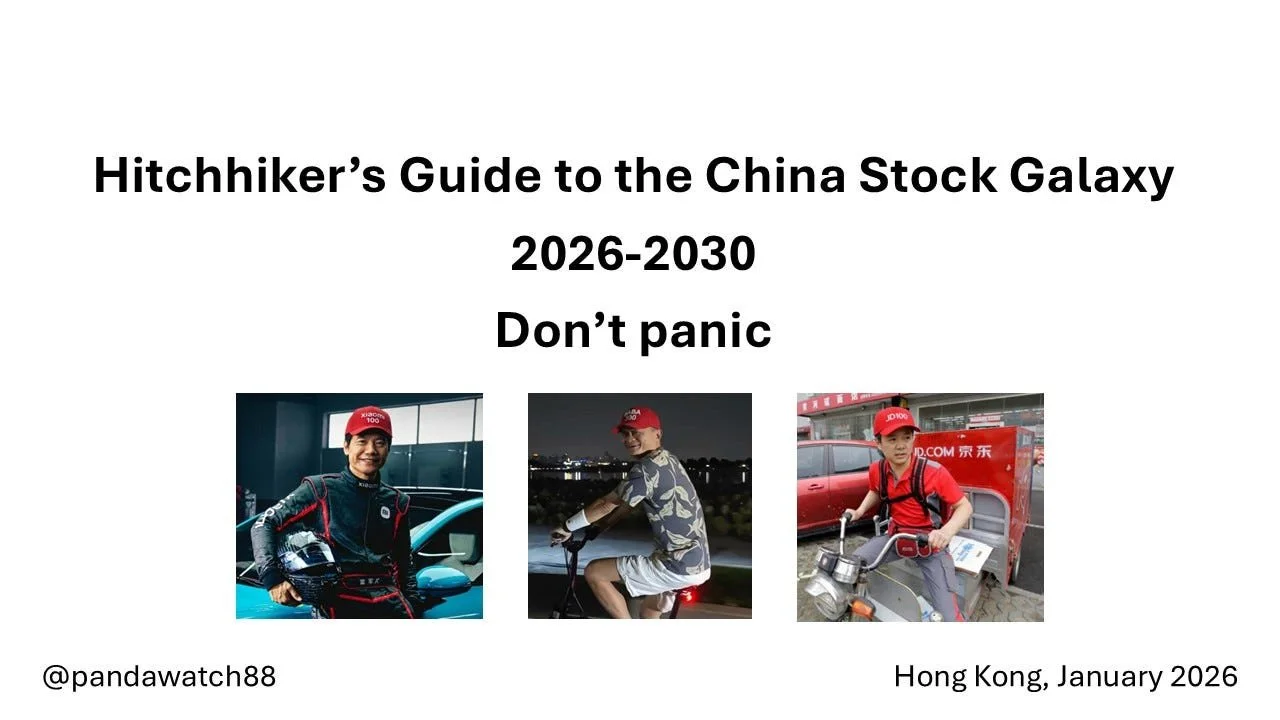
I spoke with Enrique Becerra (aka @pandwatch88) about a presentation he recently published, titled “A Hitchhiker’s Guide to the China Stock Galaxy: 2026-2030”.
It’s a lighthearted but serious attempt to cut through the noise that surrounds China and to bring some practical structure to the question every allocator eventually faces: how do you size China, if at all, when the risks are real but the opportunity set is too large to ignore.
If you already follow China closely, you will recognise many of the flashpoints, but you may still find Enrique’s framing useful, especially his focus on index distortions, valuation dispersion, and the difference between narrative risk and investable risk.
And if you do not follow China, this is a good entry point: a sceptic-friendly walk through the core objections, the data behind the bull case, and what would have to be true for China exposure to make sense in a global portfolio.
As always, this conversation is for general discussion only, not investment advice.
You can read the transcript below or listen to our conversation on Apple Podcasts (link), Spotify (link) or wherever you get your podcasts.
The following transcript has been lightly edited for clarity:
Graham Rhodes: This is Graham Rhodes, and welcome to the Long River Podcast. I’ve had a lot on over the last six months, and I’m happy to restart the podcast after a long pause, especially to introduce you to my guest today. His name is Enrique Becerra. You might know him from X as Pandawatch.
Enrique is from Spain and moved to Hong Kong almost 20 years ago to pursue a career in investment banking in Asia. These days, he’s one of the most irreverent, fun, and insightful China watchers I can think of. I invited him on the podcast to talk about a presentation he shared recently titled A Hitchhiker’s Guide to the China Stock Galaxy, in which he tackles, head-on, some of the commonly held beliefs and misbeliefs about investing in China.
A quick note before I go any further. My conversation with Enrique is for general discussion only. It’s not investment advice, and nothing we say is an offer or solicitation. I think it’s especially worth emphasising that Enrique has no agenda to push and speaks for no one but himself, though, as he shares regularly on X and Substack, he is heavily invested personally in Chinese equities.
You don’t have to agree with him, but I think it’s worth considering the points he makes and the data he uses to argue his case. With that, Enrique, welcome to the podcast.
Enrique Becerra: That’s awesome. Thanks a lot, Graham. First of all, it’s very cool to be doing this with you. I have huge respect for the way you think. We have fantastic brainstorming sessions, so I always enjoy talking to you.
Enrique, why don’t you set the scene for us and give us a brief introduction to who you are, and how you ended up where you are today.
Sure. My career is actually quite straightforward. I was an investment banker for 17 years, all the way from analyst to managing director. I came to Hong Kong in 2007, which, as you remember, was a crazy time. You had three IPOs every day. The market was going nuts.
It was a lot of fun. During my time in banking, my clients were primarily private equity firms. So my job was to find them companies to buy, help them sell them, and so on. I did a lot of M&A, LBOs, and IPOs in China, Korea, Singapore, et cetera. And then in 2017, I started investing my own money.
At first I went quite broad, and of course I made a lot of mistakes. You’re in your late thirties and you think you know everything, and it turns out you actually don’t. That requires some adjustment. And here we are today.
We’re here today to talk about a presentation you released earlier last month. It’s called A Hitchhiker’s Guide to the China Stock Galaxy 2026 to 2030. You framed it as a presentation aimed at bringing some clarity on how investors can approach the Chinese market in practice.
Why don’t you introduce the presentation to us and explain what prompted you to prepare it and share it with the world?
Sure. In January last year, I started writing a monthly post on the China market, where I talk about where I’m making money, where I’m losing money, and why, mainly to have conversations with other investors.
In some of those recent conversations, especially with fund managers, I kept hearing how difficult it was to engage with US and European allocators, pensions and endowments, families, et cetera, about China.
Because nobody wants to explain to a board or to clients why they’re putting money in China, right? There’s career risk. There’s always going to be someone in that board meeting with a strong opinion saying, “What about Jack Ma?” “What about what happened to the education companies?” “What about Taiwan?” And the allocator who isn’t deep in the topic isn’t going to get into a debate on something they don’t fully understand, especially when there seems to be a pre-agreed conclusion to the question. They have school fees to pay. I fully understand that.
But the result is a weird situation where you have the second-largest equity market in the world, and the people in charge of allocating global risk are operating in an environment that’s not conducive to having a debate about how to measure the risk, or how to measure the reward, which is the other side of the equation.
And I think that without an informed view on both sides, risk and reward, you can’t really size a bet. Don’t get me wrong, once you’ve done the work, you might still decide the right size is zero. But at least it’s an informed view.
So I thought, since I’m familiar with the topic and I’m putting money behind it, let me contribute something to the debate. And I’m not sitting across the table raising money, and I’m not in fear of being fired by a board. So I hope my views can help frame the issue.
Yeah, I think that’s really interesting. And when you talk about career risk, or how easy it is to conclude that you’re just going to pass on Chinese equities, why don’t you set the scene a little bit by telling us how much Chinese markets comprise of global indices? Because I found the statistic really shocking.
Yeah, that’s an interesting one. There’s a big gap between China’s equity market weighting in global indices and China’s actual market cap. If you add up Hong Kong, Shenzhen, and Shanghai, you’re looking at around $22 trillion of market cap. That’s larger than Europe, which is around $20 trillion, give or take. It may have changed recently with the euro moving up, but it’s broadly similar.
And yet the weighting China gets in the main global indices is about 3%, which is basically the same as Canada. That’s pretty wild. You see it in MSCI and in other major global index families as well.
There are reasons for it. They don’t just weight markets purely by market cap, especially in emerging markets, and they probably don’t want to make very abrupt changes either.
But it’s interesting. This weekend I was listening to Norges Bank’s 2025 results presentation. They’re managing about $2.2 trillion in Norway’s sovereign wealth fund, and their US allocation is around 55%. That’s not the same as the index, where the US weight is higher. A US weight of 55% is closer to market cap reality, where the US is roughly half, and China and Europe are closer to the mid-teens each.
So there’s a massive global underweight to China. Some sovereign wealth funds are starting to reduce that underweight. I don’t expect it to close any time soon, but it’s there, and it could narrow. I think global allocators should keep that in mind.
So despite China being the second-largest economy in the world, it’s basically a rounding error in terms of its weighting in global indices, isn’t it?
That’s right.
And you set the scene in your presentation by putting a few facts on the table before you make any assertions or offer your own views. The first section is very succinct. You say: “Money is being made.” Tell us about that and what it means.
Yeah. I think you have to start there. You have to start with the reward part of the discussion before you move into the risk. Otherwise, why are we measuring the risk if there’s no reward?
In my view, there’s still a widespread belief that, yes, China has the occasional year where it outperforms, but overall you’re not going to make any money there. And when you look at the numbers, that assessment isn’t really correct.
Let me give you a couple of data points. If we think about the best risk-reward trade globally over the past 15 years, it’s been US tech, right? You pick Microsoft, Apple, and Google, and over the past 15 years they’ve done almost 20x. That’s incredible, especially because these were already large companies at the start. This wasn’t some tiny business you had to dig up.
But then you look at China over the same timeframe. Fifteen years ago, the blue-chip tech name in China was Tencent. It wasn’t a small company. It was around a $40 billion market cap business. It was the largest tech company in the index and about the 12th-largest company overall. And it has delivered basically the same return, around 20x in 15 years.
So it’s not a question of “China” versus “the US” in the abstract. It’s a question of the trade. The trade has been available on both sides.
I agree that at index level, if you line them up, China has significantly underperformed the S&P 500. But the reason is pretty straightforward. Fifteen years ago, the top ten names in the China index were banks, energy, and telcos. There was basically no tech. Meanwhile the S&P 500 already had Microsoft and Apple in the top three, and Google was around number ten. So at the index level, China was not set up to reflect what actually compounded.
And if you look at more recent history, yes, last year China performed well, but that’s just one year. If you look since 2020, China has outperformed in a couple of years, the US has outperformed in three years, and one year was roughly even. It’s not as one-sided as people assume.
And you also have more signs that serious investors are active there. You saw Citadel applying to open and get licensed in Shanghai to do trading and asset management. You saw Bridgewater making strong returns last year on their China fund. You saw other China-focused funds doing very well too. So yes, I think money is being made.
Just to hammer this point about index construction. What has gone wrong with the China indices?
There’s a telling statistic, at least as of January last year, that if you’d invested in MSCI China 30 years ago, per capita incomes have risen maybe 10x, but the index has basically been flat. It hasn’t been a great way to participate in the China story at all.
You mentioned part of that is the weighting of the constituents. But why has it been so off compared to the US?
I think it’s been two things, and it depends on the time period you pick.
One is the sector composition, the weighting of the constituents, like we said.
The other is the unfortunate reality that at the index level, some companies get added at huge P/E multiples. For example, when Alibaba and Didi were added to MSCI, they came in at very high valuations. They were hot IPOs. They go into the index, and then those companies go from, say, 50x or 80x earnings down to 10x.
Meanwhile, in US retail and e-commerce, names like Walmart and Costco went from trading at, say, 10x to 20x earnings back around 2012 or 2013, to trading at 40x or 50x today. So when you combine sector weights with that kind of valuation path, the China index ends up looking like a disaster.
One thing you try to do in your presentation is update people. They may be anchoring on a China that existed a few years ago, and you try to update them on a few key things that have changed. Why don’t you walk us through some of those changes?
Sure. A lot is changing. And it’s not only China, it’s other places too.
But one of the big recent changes in perception is China as a viable, more independent power. They’ve been tested pretty hard in the trade war, the tech embargo, and capital market restrictions. And they’re coming out of that with a degree of independence that other countries or regions don’t seem to have. I think that has investment implications.
And I know this isn’t the formal definition of “superpower,” but it pains me as a European to see that Europe hasn’t been able to produce a leading-edge foundation model even three years after GPT-3, while China has five or six, basically on par with the US. If you’d asked someone five or ten years ago, that outcome wouldn’t have been obvious.
The other big change is that the US, which has dominated tech for three decades and still dominates today, now openly feels the need to race China. That’s in their own words. Not only in AI, but also in biotech, energy generation, and other areas.
And by the way, if this competition is managed responsibly, it’s a good thing for the world. You get more people working on hard problems than before. But I do think it’s a shift that wasn’t as obvious pre-2020.
What did you think of the outcome of the trade war? It’s been almost 12 months since Liberation Day in 2025. Are you surprised at all by the outcome?
I’m not that surprised, because I didn’t have a strong view on exactly how it would go.
I was surprised that, six months after the trade war started, the message from the US side was basically, “If you don’t retaliate, you’ll be treated fairly.” China retaliates; Europe didn’t retaliate. And then six to nine months later, here we are, making trade deals with China, calling China the G2 together with the US, while at the same time you see how Europe is being treated.
Without getting political, it’s a very different outcome for those two places. And of course, these things can change overnight. But yes, I’m surprised the divergence has been that stark.
I think another amazing thing has been the degree of domestic innovation in China, precipitated not necessarily by this round of trade wars, but by the earlier ones in the first Trump presidency. Tell us about that.
Yeah. Starting around 2018 or 2019, there was a big push in China. People could see what was coming, and they started to respond.
For me, the number one theme, which also has clear investment implications, is import substitution. I talk about it in the presentation. It’s a very obvious trade. China decided there are certain industries where they need to stop being reliant on imports, because one day they might not get them.
And this goes well beyond chips and semiconductor manufacturing. It goes into areas like enterprise software. It goes into aerospace. It goes into lab equipment, like bioreactors, and automation equipment that used to be sourced from Germany and Japan. That trend started around 2018 and 2019 and has been growing quickly since.
I think it’s an investable theme for people outside China because it’s relatively easy to see and to draw parallels between companies.
Europe and other countries are now following, but I don’t think they felt the threat as early as China did. So China got started sooner.
And from an investment perspective, you have to focus on two things. First, can they actually reach the required level of technology? In some areas they might, in others they might not. Second, even if they get there, will there be profits to be made? Those are, to me, some of the key outcomes of the first trade war.
You try to address the question of whether the recent performance of Chinese equity markets is sustainable. What do you mean by “sustainable,” and how do you try to answer that?
In my view, there are enough ingredients out there to be constructive on China. But there are no straight lines. You have to plan accordingly. And honestly, that’s true for a lot of other big questions too. Is AI capex sustainable? Is global debt sustainable? Are US margins that benefited from outsourcing sustainable? Maybe not. You have to plan for both outcomes.
A different way to frame the question is: what would make me leave? What would make me conclude that the sustainability isn’t there?
For me, it would be either a mistake in the thesis or a better proposition elsewhere.
A mistake in the thesis would become obvious if you start seeing the leading companies stagnating in earnings. That hasn’t been the case so far, but it’s a clear signal to watch.
A better proposition elsewhere would be something like Alibaba and JD trading at 50 times earnings while Walmart and Amazon trade at 10 times. In that world, I’d say the better opportunity is elsewhere. Today it’s the other way around.
Why don’t you talk us through some of the key risks people perceive in China, and your thoughts on them? What are the usual concerns?
There are a lot. In the presentation, I pick seven of the most commonly cited risks about investing in China.
I think most of these risks start with something that is true, but not necessarily the full picture. That’s usually how narratives get built. You pick a true fact, and then you build around it.
I’d split them into two groups. Some, in my view, are narrative-heavy and light on substance. Others are more serious and deserve real attention.
Let me give you a couple of examples from the first group.
One is when people say, “China is ultra-competitive, so your profits will go to zero.” That idea has become trendy. People will say, “I read this book,” or “I saw this tweet,” or “I visited a factory and it was so competitive.” It sounds thoughtful and logical, but when you look at the numbers, the story doesn’t hold as a general rule.
The true part is that in some industries, like solar, competition has been brutal and people have been burning cash. There hasn’t been profit there for years.
What breaks the broader claim is that in other very competitive industries, like EVs, consumer electronics, retail, and e-commerce, you have market leaders making good money.
For example, BYD was making losses in 2019 and now it’s making around $5 billion of profit. Xiaomi was making around $1 billion in profit in 2019 and now it’s closer to $5 billion. In consumer electronics, you have names like Midea and Haier that have roughly doubled profits over the same period. And in e-commerce, industry profits in 2024 were multiple times higher than in 2019.
So yes, competition is real, but it doesn’t automatically mean profits go to zero.
And by the way, losses are not uniquely “made in China.” A large share of companies in major global indices have negative earnings.
Another narrative-heavy risk is when people say, “Profits are kept in China because the government doesn’t like rich people.” People add a line like “Don’t be the tallest tree,” which sounds plausible. But again, when you look at the numbers, it doesn’t really hold.
China today has around 20 listed companies with market caps above $100 billion, and about half of them are owned by entrepreneurs. Ten years ago there was basically only one. So that claim doesn’t fit reality either.
There are other risks in the deck, but the three I think are more legitimate are these.
First, the history of the Chinese equity market is short.
Right.
Enrique: In the US, public markets and private enterprise have been around for roughly 200 years. In China, it’s more like 40 years. And private enterprise 40 years ago was a very different world. So the modern private sector, as we understand it today, is really only the last 15 years or so.
Because the US has had so much time, there’s a fairly settled view that public companies are not expected to take on excessive social responsibilities. That shifts a bit over time, but the core mission is clear: maximise profit and shareholder value.
In China, that consensus may not be fully formed yet, because the experience is so brief. Today, listed companies are expected to serve what they call “national development goals.” If you’re investing in China, you need to understand what those goals are, and you need to remember that they can change. That’s a real difference, and it matters.
Second, regulation moves very fast in China, for good and for bad.
That’s obviously a risk, especially if your investments aren’t aligned with those national goals.
And in many cases, regulation isn’t completely sudden. Take the after-school tutoring ban. Those education stocks fell around 80%, but the ban came after years of warnings in official statements and state media about the pressure this industry put on families. Investors kept buying anyway, and when the regulation arrived the stocks were trading at very high multiples.
So you could see the risk building, even if you couldn’t know the exact timing. You then have to decide whether to stay in and take that risk, or move somewhere else.
In other cases, regulation comes as a response to company actions that are perceived as harmful, as with Ant Group and Didi. In other cases, regulation comes because the regulator sees a company exploiting an advantage that it views as unfair. For example, regulators have moved against online lenders, and more recently there was scrutiny around Trip.com, where the regulator feels the company has too strong a market position.
You can often see the potential issues, but you don’t know the timing. Again, you decide whether to stay in and manage the risk, or step aside.
On regulation, do you think it’s a question of familiarity, or a language barrier that makes shocks seem much more sudden and unexpected in China than they should be? Or is there something about how Chinese policy is made and implemented that truly makes it happen faster than in other places?
I think it’s a combination of both. In China the law-making process is fast. They’ll issue consultation papers, people give feedback, and then six months later you have a law. The implementation can be messier because it then has to filter down through provinces and counties. But the actual promulgation is fast.
So when something starts to develop, people don’t wait around. They assume it’s going to happen and they move forward.
On the language side, I don’t think it’s only a language issue. My Chinese isn’t that good. But if you do the work, you can usually see what’s coming and where the risk is.
For example, on the Trip.com situation, I had a debate with someone we both know. We could see they had something close to a monopoly position, with around 60% market share, and they were making good money from it. The debate was about probability: is the chance of regulatory action 30%, or is it 80%? One person thought it was 80%, I thought it was 30%, and it turned out it happened the next week.
So you can often see these things coming. You don’t need special foresight. The hard part is timing, and deciding whether you want to be in it, or stay away and manage the portfolio accordingly.
So we’ve talked about the risks, and it’s important to balance those against prospective returns. What do you think are the reasons to be invested in China over the next five years?
And you’re a particularly interesting person to talk to about this, because you have no reason to be invested in China. You could be invested anywhere in the world.
Yeah, that’s right. When I started investing in 2017, China was about a third of my money. That felt like a reasonable starting point.
But fast-forward to 2023 and you had Amazon, Costco, and Walmart trading at 40 to 50 times earnings, while Alibaba was trading at about eight times, with something like a 12% free cash flow yield. That seemed extreme to me. And you could broaden that to other names too. Tencent and Xiaomi were in the mid-teens on earnings, while Meta and Apple were up around 35.
So yes, I’m a global investor, but at that point I felt the relative pricing had become very stretched.
And to be fair, there were reasons for that difference. If you travelled to Shenzhen or Shanghai then, the vibe wasn’t good. Everything felt slow compared to pre-COVID. And there were company-specific issues around Alibaba, Didi, and others. But the market was pricing that this would go on forever.
And I thought maybe it would, but maybe it wouldn’t. I liked the risk-reward, and that’s when I decided to go a lot bigger in China.
And on the setup, you and I have talked about this before, and I think you’ve written about it too. It felt a bit like the US in 2011 to 2013, after the real estate crash. You had Microsoft and Apple trading at eight to ten times earnings and nobody wanted to buy equities. The S&P 500 had effectively gone nowhere for over a decade, and it still hadn’t recovered to the dot-com peak. People’s savings had been hit hard in the housing bust.
That feels similar to China now.
And what’s interesting in those environments is the narratives you hear. For Apple back then it was, “They’re maxed out. Everyone already has an iPhone, so where does growth come from?” For Microsoft it was, “Nobody’s going to use PCs anymore. Everyone will use tablets.” Nobody was talking about subscriptions or cloud.
Those environments lead people to build narratives that might happen, but might not. And if they don’t happen, the upside can be large. In the US, some of those stocks went up 20x over the next 15 years.
That doesn’t mean the same thing will happen in China, of course, but I think it’s an interesting setup.
I agree. It goes back to anchoring and perceptions of risk, which you just elaborated. So against that backdrop, tell us how you’re thinking about how the Chinese economy might develop over the next five years, and how that shapes where you’re looking for investments.
It’s very difficult to forecast five years out. But as I said, I think there are enough ingredients to be constructive, and entry points have been interesting.
There are a few gaps that might close. One is allocation, meaning where global money is positioned. Another is valuations. Another is technology gaps that China is working to close in some of the sectors I talked about around import substitution. Those are all areas I pay attention to when I look for ideas.
There are a couple of other themes too.
One is services exports, which is more recent. China is still exporting goods, and the quality of those goods is going up. China is selling more cars into places like Europe and Canada. We’ll see how long that continues, but goods exports are still a big part of the story.
Services exports have been less of a focus historically. Obviously you have TikTok, but beyond that it hasn’t been as large. I think there’s an opportunity there, because products in China are good, the technology is good, the algorithms are good, and the teams are strong.
You can see Chinese service businesses expanding across Asia, for example Trip.com, and some fintech and lending platforms. So I think people should pay attention to services exports, including software exports, as long as they’re not in sensitive areas.
Another theme, which I know you think about too, is the expansion of local capital markets.
We’ve talked about the trade war, tech restrictions, and capital market restrictions. China has realised it needs functioning, independent capital markets, because it can’t rely on raising money in the US or from US investors, and Europe is a question mark too. So they need a self-sustaining local capital market in Hong Kong and onshore.
And I think that’s moving in the right direction. The number of mainland tech companies listing in Hong Kong has been very large. Southbound flows have grown a lot, and you’ve seen a push to develop the market further, including making room for businesses like AI foundation model companies to list in Hong Kong.
Maybe five years ago you would have said, “They won’t allow that. It’s too speculative.” Now it’s happening, and valuations look more sensible than people might assume. So yes, I think the development of local capital markets is a big theme, and there are different ways to express it.
Another interesting point you make is that some of the Chinese firms that have gone public recently are much younger, and at earlier stages, than their US counterparts, which have tended to stay private for much longer than they used to.
Enrique: Yeah, they are. And first of all, we still don’t have a $1 trillion market cap company from the mainland.
No.
Tencent is probably the closest. But then you also have Alibaba, CATL, BYD, Xiaomi, and Pinduoduo. One of those companies is going to get to a trillion at some point, and for several of them that would mean two to three times returns from where they are today. That’s interesting on the existing large-cap side.
And then you have a lot of new stuff coming, with real tailwinds from the government because these companies are helping close technology gaps.
You can point to companies like Unitree, and some AI and robotics names that are going public. You can also point to foundation model companies. There’s a wave of high-tech businesses that are relatively unique to China, with strong growth, that may become investable.
Now, I’m not the kind of investor who naturally chases an IPO at 150 times sales. But when you put more interesting things on the shelf, the shop becomes more interesting. More people may look at China as a place to express some of these themes.
Another question I have for you, Enrique, is how you translate these higher-level thoughts into your day-to-day research practice. And again, you’re an interesting person to ask because you live in Hong Kong and you have an investment banking background.
How do you get comfortable investing in these companies in practice, turning them from an idea into something you’re actually willing to put money behind? Do you spend a lot of time on the mainland, for example?
Some, but not a lot. My home is Hong Kong. I go up to the mainland to see friends and to get a sense of what’s going on, but I don’t do long, intensive due diligence trips.
And the reason is that, for investment purposes, you should treat China the same way you treat any other country. I don’t think there’s anything particularly mystical about it. Obviously it has its own culture, but so does every country.
People buy ASML in the Netherlands and they don’t speak Dutch. They don’t know the name of the Dutch finance minister, or the inner workings of the Dutch parliament. Same with buying SK Hynix in Korea. Do you need to know the politburo to buy Xiaomi? I don’t think so.
Buffett doesn’t speak Japanese. And I’ve read he doesn’t even like sushi. And he doesn’t strike me as someone who reads about Japanese domestic politics in detail before buying five trading companies in Japan.
So I think you can take a similar approach to China. You still want to make informed decisions, but you don’t need to turn it into something exotic.
In my view, you need enough information on two or three things. First, the general direction of the country. Second, what the company and its competitors are doing. Are they making money? Who’s winning share, who’s losing share? And third, what management and people in the industry are saying.
On those things, there’s plenty of public information available. Company filings are easy to find, and transcripts as well. If you want a daily view of politics and headlines, I think Caixin is pretty good. If you like longer interviews and long-form reading, you can use the South China Morning Post. And if you don’t read Chinese, your browser can translate a lot of it.
So yes, I’d approach it the same way as if you were investing in Switzerland, or the Netherlands, or France.
And I’d add to that. The LLMs now are fantastic at finding and translating Chinese-language sources, if you want to prioritise what’s actually being said in Chinese about these companies and what’s going on. That’s a useful tool that’s really come of age in the last 12 to 15 months.
I agree. It’s pretty cool and pretty useful.
And China has a few features that other markets don’t, which can be helpful. There are big forums of retail traders. You’re not going to get a lot of signal from that, but it does help you understand sentiment.
And for some companies, investors submit questions and get answers in public, and the companies publish those Q&A sessions. In other markets, that doesn’t really happen.
So there’s a lot out there to form a view. And if a company is too obscure, you don’t have to dig into it. There are about 8,000 listed companies in China. You don’t need to know all of them.
Exactly. It’s one of the broadest markets on earth. You don’t need to understand everything.
I was going to add one more enticement for people to follow you and subscribe to your newsletter. You also have amazing restaurant reviews, and they always come with a recommended wine pairing. So if anyone is planning to visit Hong Kong, you’d do well to look at the restaurants where Enrique is dining.
Yeah. It matters. We work for a reason. We work to enjoy life.
One of the more interesting challenges is: how do you pair local food with good wine? The wine is made somewhere else, the food is made here. I’ve got a good group of friends who enjoy that hobby too.
And Hong Kong is unique for it, because you have access to fantastic food and fantastic wine. So yes, definitely reach out for recommendations.
So just as we wrap up. You prepared this presentation as a contrarian take on what you see as the consensus about China. And if I were reading something like this myself, I’d be sceptical. I’d want to kick the tyres and verify things.
What do you think you’ve left out? Or if you were a sceptical reader, what would you want to take further?
I think, first, you need time and motivation to look into China. If you’re looking at it from the outside, it can feel annoying. And it will be different for every person.
If you’re sitting in the US and you only invest in the US, you don’t need to look at China. And if you want some China exposure, you can just buy an index. That’s fine.
But if you’re someone who already buys individual stocks internationally, like TSMC, ASML, LVMH, or SK Hynix, then whatever diligence you’re doing for those should apply to China too. You can do the same work, and in some ways even more.
The other point is that some people don’t really want to measure risk. They want to think in binary outcomes.
We didn’t talk about Taiwan, for example. Some people say, “Why am I going to spend time learning this when one thing could make it go to zero?” And you should question that framing. Nobody knows what will happen, but people often reason by analogy too quickly. They assume that if there’s a conflict, China equities are automatically a zero, because that’s the analogy they have in their head.
I would question that. I’m not sure it would play out that way. And to state the obvious, China is not Russia.
Also, if that’s your strong view, and the way you manage that risk is by allocating zero to China, then you probably need to allocate zero to Nvidia, or to anything AI-related, or to a large portion of the S&P 500 that relies on China in the supply chain.
So I think people need to pause and not treat everything as a binary outcome. If it’s not binary, then you need to spend more time measuring the risk, and figuring out what the right allocation is for you.
I agree. You’ve also been very anchored on valuations, pointing out that in 2023, things got quite extreme, especially relative to the alternatives.
And if nothing else, that’s a good signal for when it’s time to move on and look elsewhere.
Totally agree.
Personally, I think even if you’re a domestically focused US or European investor, the surface area across which China affects your coverage is getting broader and broader. It’s not just, “Okay, this is a supplier to one of my retailers.” Now it’s, “This is a major competitor” to high-end industrial companies, technology companies, and even consumer companies. It’s simply too important to ignore, in my opinion.
Yeah, I agree with you. If you’re in the US and you own Applied Materials or Lam Research, you need to pay attention to NAURA in China. Market share is moving. Money is moving from one to the other. You don’t know how the technology is going to evolve.
So you’re right. It’s not just about a component manufacturer or someone selling to a restaurant chain in Shanghai. As you say, it touches your investments. So take advantage of it.
Totally. Or even more mundane things. If you cover high-street retailers in England, you have to know what’s going on with AliExpress and Temu to understand why sales have been falling off so dramatically.
Is there anything else you’d like to share with us about this presentation, Enrique?
No, I think this Q&A touches most of it.
And obviously I’m biased, because I’m backing these views with my own money. And I’m also close to the topic, which might make me miss certain things.
But I love the dialogue, and I like people pushing in different directions. Hopefully the presentation helps people in the business have a more detailed discussion about risk and reward, and make more informed decisions.
Yeah. And you’ve said yourself that one of the best things about writing publicly is the feedback you get, and the conversations it creates. So if anyone wants to follow you or find you, what’s the best way to get in touch?
Just send me a message on X. I’m @pandwatch88.
I love the debates there. There’s a lot of noise on the platform, but I’ve made good friends on it, and there’s an incredible number of thoughtful people with interesting views that help you think. So yes, reach out there if you want to explore this topic more.
Thank you, Enrique. It’s been a real pleasure speaking with you today.
Enrique: Cool. Same here. And Graham, I really appreciate the time we spend brainstorming together.